


How to Architect a Scalable dApp: From Smart Contracts to Frontend Integration
Understanding dApp Architecture Fundamentals
The internet as we know it isn’t a linear thing that was created as it is today, and neither do we use it now as we will use it in the next few decades. The web can be divided into four main stages: Web 1, Web 2, Web 3, and Web 4, and they coexist, though each has its own specific use and circumstance. To keep it short, Web 1 was dominated by static webpages, the simplest type of website one can create; Web 2, on its part, introduced dynamic web apps, allowing for the creation of social media and networks. Web 3 is based on the premise of creating decentralized applications (dApps), wallets, NFTs, etc., using blockchain, and, finally, Web 4 is still very theoretical, but so far it’s the version that employs AI in workflows.
So, given that Web 4 isn’t even a properly defined concept yet, Web 3 is still the most modern approach to the internet and usually what’s most advanced. And, to excel with it, one must understand decentralized application architecture, which basically consists of blockchain, smart contracts, and frontend integration. So, let’s introduce you to Web3 and dApps, building scalable blockchain applications, and how to explore this very innovative and somewhat mysterious part of the software engineering industry.
Smart Contract Architecture: Designing for Security and Scale
One could say that smart contracts are the smallest functional part of the decentralized application architecture. It is more or less like the backend of the application: it’s the actual service that runs the logic and handles things like payments, wallet management, etc. They’re usually developed using a programming language named Solidity, which is more or less similar to JavaScript, but it is compiled directly into binary code to be able to work in the blockchain. Contracts are, then, the absolute source of truth for a dApp, and it’s where critical trust is.
Smart contracts are also usually developed using three key design patterns: proxy or upgradeability, factory contracts, and access control. Here’s a short overview of them:
- Proxy (upgradability): Once you compile and put a contract in the blockchain, like Ethereum, you get an address for your application and can’t change it anymore. It’s there like that forever. The proxy, then, is needed to keep evolving and developing new features for a service: if you need to upgrade the system, you get the address of the new contract and have your app use it. Conceptually, this makes the contract “updatable” without compromising the blockchain’s immutability.
- Factory contracts: The factory pattern is the go-to solution to deal with scale and standardization. With it, instead of needing to create new contracts by hand, you create a blueprint and give a contract the task of creating other contracts. It is of most use when a user or entity needs its own instances of contracts (such as wallets, pools, NFTs). With it, each contract will have the same code pattern and initialization, and all of them will be trackable back to the initial contract.
- Access control: This pattern defines who exactly can do what in a contract. In decentralized systems, it is more or less the same as traditional authentication logic. The default is to have an “owner” flag, but more robust systems can have different roles as well; this is a critically important pattern, as dApps usually deal with real active in the blockchain, such as cryptocurrencies. Any bug can lead to devastating money loss, and, in a blockchain environment, this will almost surely be irreversible. So, the design is very explicit: each function must be clear as to who can run it and why.
Now, there are some things you must consider carefully when creating smart contracts: running code in the blockchain isn’t free. The computational power used comes at a price through a fee called gas. To do so, usually you must pay in Ethereum, and your software must be very well optimized to deal with it: reading variables requires very few gas, but writing in storage takes a lot of it, and things sum up quickly. Also, note that if you start a transaction but don’t have enough gas to complete it, the transaction will stop, and your progress will be lost. Also, you must pay heavy attention to security, most of all preventing attacks such as reentrancy and overflow, as we will understand later.
How dApps Interact With Each Other
In the dApp development architecture, different applications don’t communicate with each other directly, as happens with traditional REST APIs. Instead, they must use intermediary smart contracts allocated over the same blockchain, such as Ethereum. It creates a composition pattern in which one contract calls the other, via what’s called contract-to-contract interaction. For this interaction to happen properly, a dApp must expose public functions that other dApps can access, as happens with public API endpoints, for instance; this then creates a composable ecosystem, called “money legos”, in an architecture that is properly displayed in the diagram that follows:
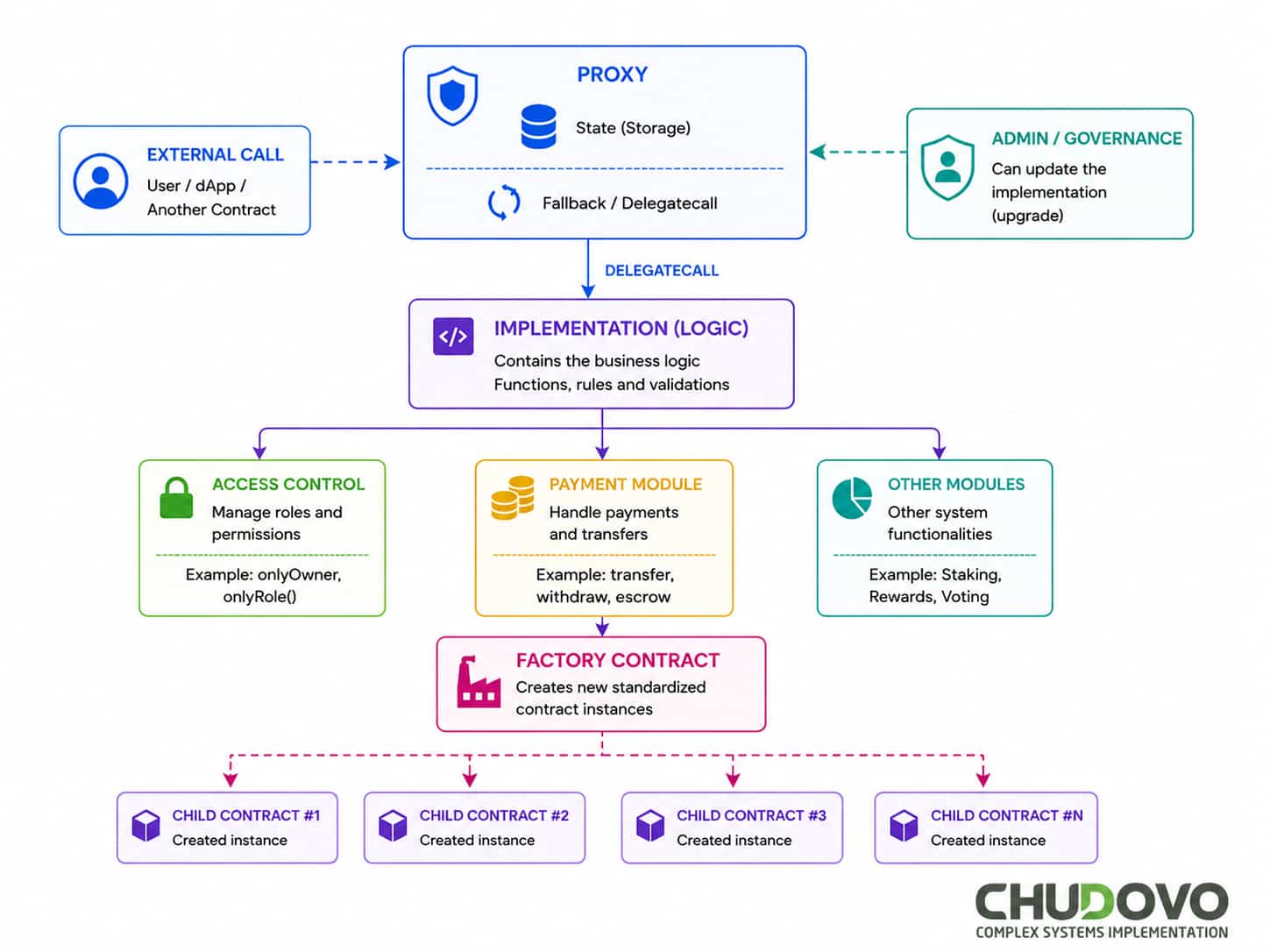
The diagram illustrates this type of interaction: the entry point is the proxy contract, which routes execution to the most recent implementation and its internal modules. Then, the interaction can also turn outwards, calling other contracts, consuming shared state already written on-chain, or triggering event logs, etc.
This architecture lets several different dApps interoperate and communicate with each other at the same time, forming a network of smart contracts, more or less like traditional microservices work. Sometimes applications reuse logic, liquidity, or data from another simply by interacting with its contracts or reading indexed outputs. The result is a composable system, and, with it, independent applications behave as building blocks within a big and structured blockchain.
Frontend Integration: Connecting UI to Smart Contracts
Still, if you develop all the best smart contracts in the world, your dApp wouldn’t be complete without a frontend for your userbase to connect to. The smart contract and frontend integration are made by using specialized Web3 JavaScript libraries, such as ethers.js or web3.js. It serves as a bridge between the application interface and the contract published on the blockchain, and it requires three main pieces of information: the contract address, the contract ABI, and the provider RPC. All of this is used to explain to the front-end how the contract is created and coordinated, what to send as a request and expect as a response, etc.
So, the pipeline goes as follows: first, the user accesses the frontend in a website or a mobile application, and connects to a wallet (such as Metamask). The wallet, then, connects to an RPC Provider to read and write data into a blockchain such as Ethereum, and then it calls the actual smart contracts with direct access to the blockchain. It goes more or less as explained in this infographic:
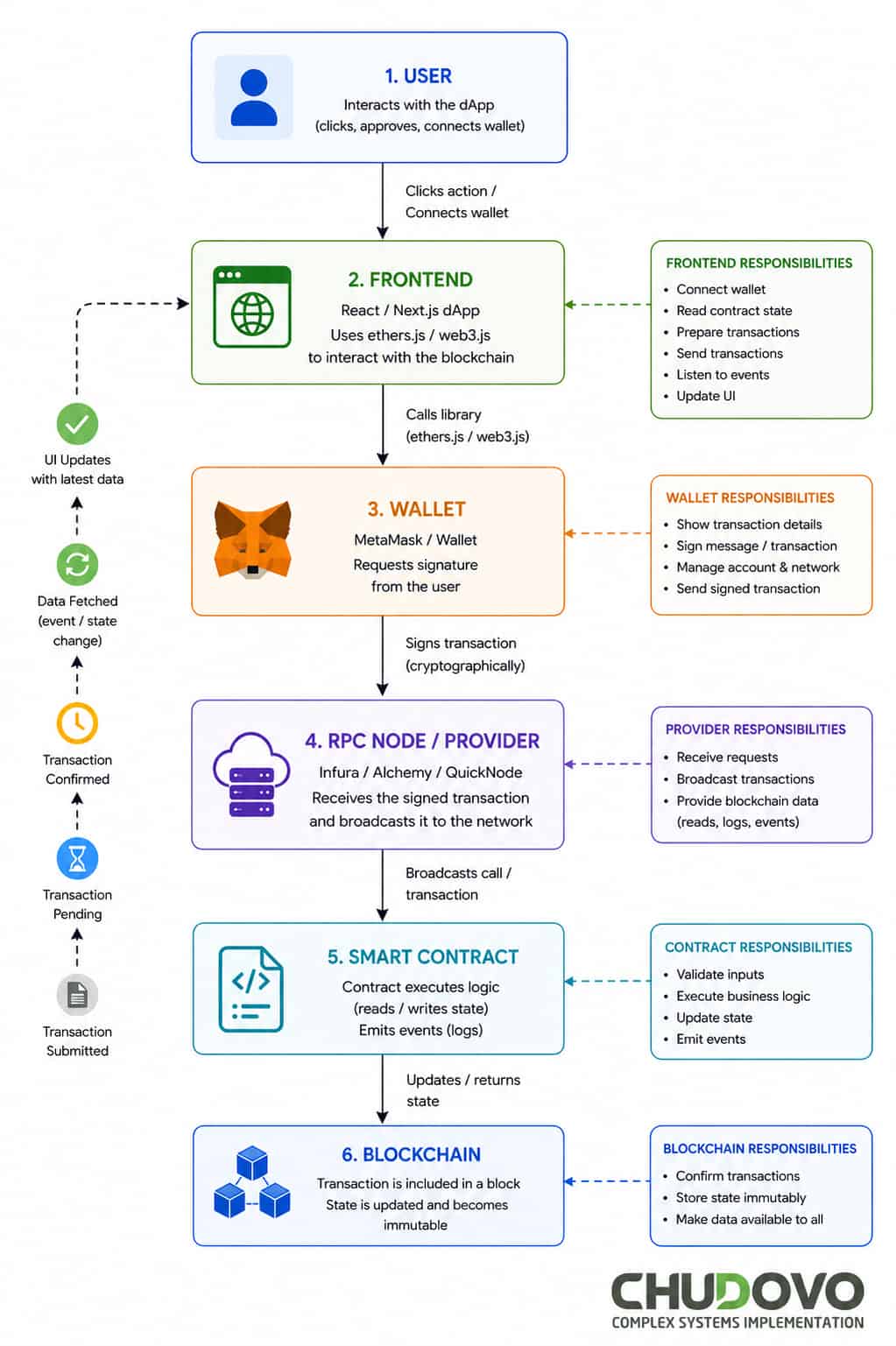
A challenge these integrations usually face is to keep the UI synchronized with the current state of the blockchain, as it handles data so differently from traditional APIs, and every read operation costs gas as well. The frontend must handle pending transactions, confirmations, and state updates, often using data directly received from the contract and joining it with indexed data from tools such as The Graph. A very common way to deal with it is to use Web3 hooks and state management strategies that ensure the interface reflects real-time blockchain changes and avoid compromising user experience.
How to Build a Scalable dApp Architecture Step-by-Step
To start defining the architecture of a dApp with an emphasis on scalability, you must first decide what will remain on-chain and what will be handled off-chain. That is, the on-chain part of your app is what will happen and be stored within the blockchain (such as smart contracts execution, writing of permanent data, value transfers, etc.). On-chain operations are slow and expensive, as they use gas, and are immutable by definition. On the other hand, off-chain is, then, everything that happens outside of the blockchain: frontend, indexers, APIs, servers, cache, etc; it’s way cheaper, faster, more flexible, and involves everything that isn’t directly money-related.
Planning it is of extreme importance, as it will directly influence how well and cheaply your application will work, and how your dApp can be useful to your user base. After that, the architecture moves towards the execution layer: smart contracts, RPC infrastructure, Layer 2, indexing, and frontend integration. Contracts, as we have seen, run the core logic and communicate with the blockchain; Layer 2 networks help reduce transaction costs, and indexing tools help navigate through the blockchain and fetch data from it faster and cheaper as well.
So, to help you better understand how more or less this works in practice, here’s an example of how an app can create a read request to the blockchain via an RPC provider using ether.js:
import { ethers } from "ethers";

const RPC_URL = "https://eth-sepolia.g.alchemy.com/v2/YOUR_API_KEY";
const CONTRACT_ADDRESS = "0xYourContractAddress";

const ABI = [
  "function balanceOf(address owner) view returns (uint256)",
  "function totalSupply() view returns (uint256)",
];

async function readFromBlockchain() {
  const provider = new ethers.JsonRpcProvider(RPC_URL);

   const contract = new ethers.Contract(CONTRACT_ADDRESS, ABI, provider);

   const userAddress = "0xUserWalletAddress";

   const balance = await contract.balanceOf(userAddress);

   const totalSupply = await contract.totalSupply();

   console.log("User balance:", ethers.formatUnits(balance, 18));
  console.log("Total supply:", ethers.formatUnits(totalSupply, 18));
}

readFromBlockchain();
With all of it in mind, we can finally start developing our decentralized application and connect to the blockchain of our choice, with the most common one being Ethereum, as usual. You must always bear in mind that every blockchain operation is costly, and this cost comes in Ethereum coins, which, at the end of the day, means that real-life money will be spent with it. So, either the customer will bear the costs, or your company, and neither alternative is really that good. With it, several different alternatives have emerged to help your app be more efficient, and you must weigh everything down very precisely.
Conclusion: Future-Proofing Your Web3 Architecture
The Web3 ecosystem is moving fast, with all things: scalability, developer tooling, and protocol design. All these things are getting better. With better RPC infrastructure, more efficient indexing systems, and new Layer 2 solutions, the way dApps are developed and scaled is changing into a way of reliability and easier scalability. And, modularity is an important architectural principle in this context. Developers can implement new technologies without the necessity to rewrite the whole system. The decoupling of smart contracts from infrastructure and frontend layers allows this.
The development of the modern dApp architecture is designed with future changes and improvements in mind. This is about being ready to jump between L2 networks, support new protocol upgrades, and performance boost, when the ecosystem grows. Scalable dApp architecture ensures that apps are secure, efficient, and adaptable over time, so that you don’t need costly rewrites but can continue to evolve with Web3.