

Blog

Machine Learning and Artificial Learning are not the new kids on the block anymore. Quite surprisingly, they have become the most liked dudes in the town, and it seems that they are here to take over the entire globe.

Angular is a cornerstone in the field of software development. It is a new-gen platform and framework for developing interactive and dynamic single-page client applications using HTML and TypeScript.
Want to know about the difference between React and Angular? Well, it would be better to start by first understanding what JavaScript is and its frameworks. JavaScript has brought several new possibilities into the development fold, with the JavaScript Frameworks making headlines for their efficacy and ability to create bespoke web and mobile applications.
Angular, a popular platform meant to develop robust applications, defines the number of lifecycle functions. As it is the response function of the event, the use of Angular constructor and ngOnInit plays a significant role in developing applications. However, the terms often confuse a developer, especially if one is new to Angular. Both constructor and ngOnInit in Angular are available lifecycle hooks that provide extensive benefits to developers in the process of application development.
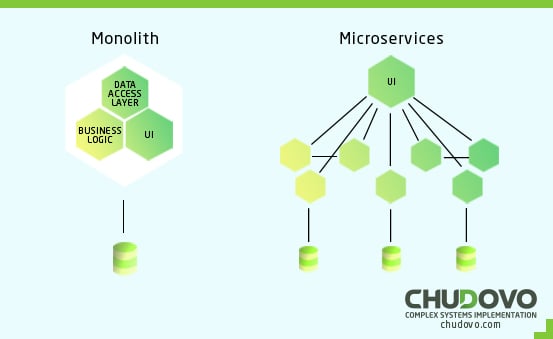
Two types of development architecture are prominent, microservices and monolithic. The monolithic structure, which has been existent for a long time, was natural selection. But as soon as microservices made headway into the industry, the developers are faced with a tough decision, which had both technological and philosophical underpinnings. The debate between monolithic and microservices is an ongoing process, and new aspects are added to their impact and utility regularly.
Magento is one of the groundbreaking e-Commerce platforms that allows programmers to develop e-Commerce websites. Ever since its initial release in 2008, the Magento platform has managed to gain incredible market share. As of now, there are more than 250,000 websites that run on the Magento eCommerce platform on the entire world wide web.

Angular is a framework and application development platform operating in JavaScript. It is used for creating efficient, scalable web applications and apps. The features of Angular are useful for creating single-developer as well as enterprise-level applications. Angular operates in JavaScript, HTML, and TypeScript (a strict syntactical superset of JavaScript).
Needless to say, software technology is making the development in the world fly like an eagle – sharp and high. All thanks to the whopping numbers of programming frameworks, the prepackaged set of solutions meant to solve the development problems. Though the availability of plentiful frameworks enhances the scope of innovation, the same also results in the bafflement between two reliable technologies. The most popular battle is going on between ASP.NET vs Node.js.
Today’s applications are not built as monoliths. Instead, they operate with integrated silos that are built separately but joined together to form a fully functioning application. Here every component may have a singular purpose, but they cannot work in isolation.

A new buzzword among advanced development organizations, Microservices was first coined in 2011. It is a state-of-the-art method used to design software applications that are faster, flexible, and stable than ever before. Also known as ‘Microsoft architecture,’ the practice heads towards a software system in which services are fine-grained, and protocols are lightweight.