

Grok vs ChatGPT vs Gemini: Which AI Tool Is Best for Enterprise Use?
Many companies used to debate whether to integrate AI into business workflows at all. In 2026, this debate is mostly over. The real conversation in any comparison is which platform fits best for enterprise use. This decision goes beyond model selection. It also includes governance structures, vendor strategy, integration complexity, compliance exposure, and long-term cost.
The wrong platform choice at the pilot stage often means expensive rework later. This affects not just licensing costs, but the entire integration architecture built around it.
In this article, Chudovo’s team reviews three of the most widely adopted AI tools for corporate use:
- ChatGPT (OpenAI)
- Gemini (Google)
- Grok (xAI)
The analysis covers the OpenAI vs. xAI vs.Gemini question from an enterprise deployment perspective, with a focus on:
- Compliance posture
- Admin tooling
- Integration fit
- Total cost of ownership
- How enterprise deployments combine generative AI and AI search to improve response accuracy
By the end, you’ll have a guide on how to choose an AI assistant for business based on the problem your company needs to solve.
ChatGPT
ChatGPT is the most widely adopted of the three options. In many organizations, employees start to use it for work-related tasks before any official adoption. This informal use reduces onboarding friction and shortens the rollout once governance is formalized.
ChatGPT’s engineering toolset includes:
- A code assistant (Codex) with agentic coding support
- Extensive documentation
- Function calling support
- Connectors for most enterprise platforms
It also covers IT and compliance requirements:
- SOC 2 Type II certification
- ISO 27001 certification
- SSO and SCIM
- Data isolation guarantees
- Admin dashboards with usage analytics
- Dedicated SLAs
This makes the platform a solid choice for developer teams.
Another strength is the maturity of the OpenAI API. It makes ChatGPT a strong choice for teams that need an AI assistant for developers who build internal tooling. Teams that develop custom AI assistant solutions or RAG pipelines can integrate the OpenAI API directly into the development workflow.
Below is a minimal RAG implementation example from Chudovo’s development team:
import OpenAI from "openai";
const client = new OpenAI({ apiKey: process.env.OPENAI_API_KEY });


async function answerWithContext(question, contextChunks) {
const context = contextChunks.join("\n\n");
const response = await client.chat.completions.create({
  model: "gpt-4o",
  messages: [
    {
      role: "system",
      content:
              "Answer using only the context provided. " +
              "If the answer is not in the context, say so.",
    },
  {
      role: "user",
      content: `Context:\n${context}\n\nQuestion: ${question}`,
  },
],
});


 return response.choices[0].message.content;
}


const chunks = [
"Q3 revenue was $4.2M, up 18% year-over-year.",
"Churn increased slightly to 3.1% in Q3.",
];


const answer = await answerWithContext("How did Q3 perform?", chunks);


console.log(answer);
The main tradeoff is cost unpredictability. A single high-volume deployment can spike usage-based pricing. The Enterprise contract may help, but it requires a full model of usage scenarios before signing.
ChatGPT also lacks deep native integration with any specific productivity suite. For custom tooling, this is an advantage. For teams that need an out-of-the-box productivity layer, it requires additional work.
ChatGPT tends to be a good fit for:
- Multi-cloud organizations
- Developer-heavy teams
- Enterprises that need flexibility in how AI integrates into existing workflows
Gemini AI for Enterprise
Gemini’s value is tightly coupled with the Google ecosystem. For organizations that are standardized on Google Workspace and GCP, it reduces AI integration friction. Identity management, logging, billing, and access control stay within a single management layer that IT teams already operate.
ISO 27001 certification and FedRAMP-authorized services are available for relevant Google Cloud tiers. Audit logging integrates natively into Cloud Logging. VPC Service Controls are available for stricter data perimeter enforcement.
With a Gemini subscription, AI features appear natively in:
- Gmail
- Docs
- Sheets
- Drive
- Meet
When it comes to the generative AI vs. AI search engine debate, Gemini is the clearest example of a platform that bridges both. The native connection between Gemini, Google Search, and internal document libraries gives it an edge in knowledge-intensive and research workflows. Several ChatGPT vs. Gemini for research comparisons consistently expose this.
The tradeoff is concentration risk. A late move to a multi-cloud model will introduce more friction than with an API-neutral platform. Google’s roadmap on model iteration may introduce behavior changes outside your control.
Gemini’s best fit is an organization deeply invested in Google Workspace and GCP, or those that prioritize vendor consolidation.
Grok AI Enterprise Use
Grok’s primary differentiator is native access to real-time public information through its integration with X (formerly Twitter). This makes it useful for social sentiment analysis, media monitoring, real-time market commentary, and policy tracking. For organizations in financial services, media, or public affairs, this is a capability ChatGPT and Gemini do not offer natively.
The limitation is enterprise maturity. Grok currently lacks SOC 2 and ISO 27001 certifications. Admin controls are in beta. SLA documentation is less developed than what OpenAI and Google provide. Legal and security reviews will require significantly more effort. Regulated industries face meaningful additional risk. Organizations should validate Grok’s current compliance posture directly with xAI before adoption.
Grok may be useful for organizations with a specific need for real-time public discourse monitoring. It is not recommended as a general-purpose AI standard at this stage.
Enterprise AI Assistant Comparison
The following comparison reflects operational posture, not model performance rankings.
| Dimension | ChatGPT (OpenAI) | Gemini (Google) | Grok (xAI) |
| Enterprise Tier | Mature | Mature | Emerging |
| Compliance Certs | SOC 2, ISO 27001 | ISO 27001, FedRAMP | In progress |
| Admin Controls | Advanced | GCP-native | Beta |
| Workspace Integration | API-first ecosystem | Deep (Google Workspace) | X platform only |
| Real-Time Data | Via plugins/tools | Via Google Search | Native (X/Twitter) |
| API Maturity | High | High (GCP-focused) | Evolving |
| Pricing Model | Seat + usage-based | Seat + usage-based | Subscription |
| Ecosystem Lock-In Risk | Medium | High (Google stack) | High (X platform) |
| Cross-Dept Adoption | High | High (Workspace users) | Context-dependent |
Tables like this one can make platform differences look sharper than they actually are. Many organizations end up with more than one platform in use:
- ChatGPT for internal development tools and engineering workflows
- Gemini for research and document analysis within Google Workspace
- Grok for tasks that depend on real-time data, such as public sentiment or financial news monitoring
Many development teams prefer to experiment and validate options per use case before they settle on a vendor. A typical pilot assigns ChatGPT to engineering workflows and Gemini to document analysis across the organization. This hybrid approach lets teams build confidence in each platform within a controlled scope before broader rollout.
Internal training and change management also require a dedicated workstream. Even a well-configured platform produces little value if employees are not comfortable with its use in daily work. Enterprise deployments require:
- Internal guidelines
- Prompt usage training,
- Department-level onboarding before the rollout scales across the organization.
This is often where the gap between a successful pilot and a failed rollout is decided. Not in the technology, but in the adoption process around it.
Enterprise AI Security and Compliance
Security reviews are where deployments most commonly stall. Compliance teams focus on AI data privacy compliance across several dimensions:
- Where data is processed
- Whether regional residency requirements can be satisfied
- How long are prompts and outputs retained
- Which certifications apply to the specific service tier under evaluation
- What audit trail is available for SIEM integration
Development teams must do more than select a certified vendor. Proper platform configuration and access policy enforcement at the department level are also required.
ChatGPT and Gemini both provide compliance documentation, DPA templates, and security questionnaire responses that reduce legal review timelines. Grok’s documentation is still in early stages.
The following snippet from Chudovo’s development team shows how to enforce department-level access and maintain an audit trail at the request level:
import OpenAI from "openai";
const ALLOWED_DEPARTMENTS = new Set(["finance", "hr", "engineering"]);
async function callAIWithAuditMetadata({ prompt, userId, department }) {


  if (!ALLOWED_DEPARTMENTS.has(department)) {
    throw new Error(`Department "${department}" is not authorized for AI  access.`);
  }


  const client = new OpenAI({ apiKey: process.env.OPENAI_API_KEY });


  await auditLog({ userId, department, prompt, timestamp: new Date().toISOString() });


  const response = await client.chat.completions.create({
  model: "gpt-4o",
  messages: [{ role: "user", content: prompt }],
  user: userId,
});


  return response.choices[0].message.content;
}

async function auditLog(entry) {
  // Replace with your logging pipeline: Datadog, CloudWatch, Elastic, etc.
  console.log("[AUDIT]", JSON.stringify(entry));
}

const result = await callAIWithAuditMetadata({
  prompt: "Draft a severance letter template.",
  userId: "user_8821",
  department: "hr",
});
One important nuance: SOC 2 and ISO 27001 certifications cover specific scopes. Always verify the certification applies to the service tier and deployment model under evaluation, not just the vendor at the corporate level.
Enterprise AI Tools Pricing and Total Cost of Ownership
Per-seat pricing only tells part of the story. A complete TCO analysis should account for:
- Enterprise license fees
- Usage-based API costs for custom AI assistant development and internal tooling
- AI integration services for business that connect the platform to identity providers and internal systems
- Ongoing observability infrastructure
- Compliance overhead
- Change management across departments
Usage-based models produce significant variance between projected and actual costs. A practical safeguard is to implement alerts before the broad rollout.
The following example from Chudovo’s team shows a basic token tracking and budget alerting implementation:
const PRICE_PER_1K_TOKENS = 0.005;
const MONTHLY_BUDGET_USD = 500;
function checkSpend(totalTokensUsed) {
  const estimatedCost = (totalTokensUsed / 1000) * PRICE_PER_1K_TOKENS;

  console.log(`Tokens used: ${totalTokensUsed.toLocaleString()}`);
  console.log(`Estimated cost: $${estimatedCost.toFixed(2)}`);

  if (estimatedCost >= MONTHLY_BUDGET_USD * 0.8) {
  sendAlert(
    `AI spend at $${estimatedCost.toFixed(2)}, approaching monthly budget of $${MONTHLY_BUDGET_USD}`
);
}
}

function sendAlert(message) {
console.warn(`[ALERT] ${message}`);
}

function trackUsage(openAIResponse) {
  const { prompt_tokens, completion_tokens, total_tokens } =   openAIResponse.usage;

  console.log(`Prompt: ${prompt_tokens} | Completion: ${completion_tokens}`);

  checkSpend(total_tokens);
}
Architecture and Long-Term Flexibility
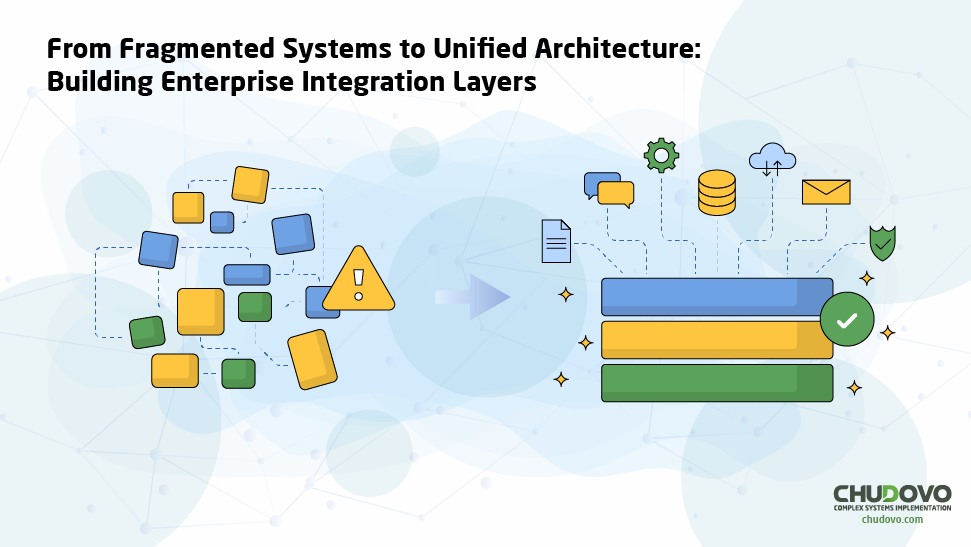
Architectural commitments made at the pilot stage are expensive to undo at scale. Companies that treat model selection as an infrastructure decision (not just a tooling one) tend to avoid the most common pitfalls.
A tightly coupled integration built around a single provider’s SDK means that a model switch later requires rework on every touchpoint in the application. Early engagement with an enterprise AI implementation company often pays off precisely because those decisions get made correctly before the codebase grows around them.
For AI integrations, the key decision is how tightly the model is coupled to your applications. The practical mitigation is an abstraction layer built around a provider-agnostic interface. This is the foundation of any durable integration approach.
Chudovo’s team applies the approach below to decouple model services from their consumers:
import OpenAI from "openai";
import { GoogleGenerativeAI } from "@google/generative-ai";


const providers = {
  openai: async (prompt) => {
    const client = new OpenAI({ apiKey: process.env.OPENAI_API_KEY });


    const response = await client.chat.completions.create({
        model: "gpt-4o",
        messages: [{ role: "user", content: prompt }],
  });


   return response.choices[0].message.content;
},


  gemini: async (prompt) => {
  const genAI = new GoogleGenerativeAI(process.env.GEMINI_API_KEY);

   const model = genAI.getGenerativeModel({ model: "gemini-1.5-pro" });
  const result = await model.generateContent(prompt);


   return result.response.text();
},


  grok: async (prompt) => {
  const client = new OpenAI({
      apiKey: process.env.GROK_API_KEY,
      baseURL: "https://api.x.ai/v1",
  });


   const response = await client.chat.completions.create({
      model: "grok-2-latest",
      messages: [{ role: "user", content: prompt }],
  });


   return response.choices[0].message.content;
},
};


export async function getCompletion(prompt, provider = "openai") {
  if (!providers[provider]) {
      throw new Error(`Unsupported provider: ${provider}`);
  }


   return providers[provider](prompt);
}


const result = await getCompletion("Summarize Q3 sales performance.", "openai");
With the abstraction layer in place from the start, a swap of the underlying model requires far less disruption.
How to Choose an AI Assistant for Business
The best AI tool for enterprise use is the one that fits your existing infrastructure and governance model, not the one that leads the latest benchmark.
- ChatGPT Enterprise offers the most mature ecosystem and the largest pool of enterprise AI consulting services and partners. It works well for multi-cloud, developer-heavy organizations.
- Gemini’s integration story is difficult to beat for organizations that run primarily on Google Workspace and GCP.
- Grok warrants evaluation for real-time public data monitoring. But before any scale-up, your company should perform a governance review.
No single platform wins across all dimensions. The right answer depends heavily on your existing stack, your compliance requirements, and how much internal engineering capacity you have to manage integrations.
The most common deployment mistake is to move forward before governance is in place. A partnership with a specialist enterprise AI implementation company can compress timelines and reduce the risk of architectural decisions that become costly to reverse.
The platform you choose matters. The architecture you build around it matters more.