



Why Companies Move to Micro Frontends And How the Architecture Works
Modern web applications are more than just a static website. They provide an endless number of dynamic interactions and content that give the user the impression that they are truly alive. However, many teams eventually run into problems as these applications grow and become more complex.
What started out as a simple one-page application typically becomes more challenging to maintain, takes longer to develop, and is riskier to alter. At that point, companies begin to reevaluate their frontend architecture and explore alternatives that better suit their teams, features, and business needs.
Micro frontend architecture is a super popular way to handle these common headaches. Think of it like this: instead of one giant, clunky front-end app, you break it down into smaller, totally separate pieces that teams can work on independently. It’s basically taking the great ideas from backend microservices and applying them to the frontend.
In this article, we’ll dive into what micro frontend architecture is all about, explore why businesses are jumping on board, see how it actually works, and share the best practices and design patterns that help teams truly succeed in their projects.
What Is Micro Frontend Architecture?
The micro frontend architecture is a method of building a website’s user interface by combining several small, independent, and self-contained applications, which are known as micro frontends. Micro frontends are designed to be autonomous units, each dedicated to a particular business domain or feature. This independence allows for separate development, build, and release cycles. Despite their autonomy, they combine within a larger container application to provide a cohesive and uninterrupted user experience.
From an organizational perspective, instead of a monolithic front-end repository that is owned by a single team, micro frontends enable multiple teams to work autonomously while still delivering a unified product.
Why Companies Move to Micro Frontends
As explained above, a micro frontend could help teams to scale their applications more cleanly and faster. Here are some of the most relevant reasons to choose this kind of architecture:
Scaling Development Teams
When a company starts getting bigger, its engineering teams do too. Suddenly, that big, single chunk of front-end code (the “monolith”) becomes a real pain point. You end up with endless code conflicts when people try to merge their work, builds take forever, and simply coordinating everyone becomes a huge headache. All of this just slams the brakes on how fast you can actually ship new features.
With micro frontend architecture, teams can own individual features end-to-end. One dedicated developer team might handle checkout, another user profiles, another analytics—without stepping on each other’s work.
This organizational alignment is one of the strongest micro frontend use cases in large enterprises.
Independent Deployments
In a monolithic frontend, a small change requires rebuilding and redeploying the entire application. That increases risk and slows down releases.
Micro frontends allow for the deployment of a single feature without impacting others; they also include other advantages, such as the option to safely roll back individual parts when necessary, and achieve faster release cycles, particularly for business-critical areas.
This is especially valuable for products that release features continuously or experiment frequently.
Technology Flexibility
A nice perk of micro frontends is that they can let teams use different frameworks or versions when they really need to, though it’s usually better not to if you can avoid it.
For example, let’s say you have your app entirely built in Angular, and now you want to migrate to React. This architecture allows you to split your app into several slices and migrate them incrementally. Moreover, it is also possible to support micro frontend architecture, Angular, and React micro frontend architecture within the same platform.
This flexibility is useful during long migrations or when legacy constraints apply.
Better Long-Term Maintainability
Think of micro frontends as keeping your house in order. By breaking your massive frontend project into smaller, manageable sections with clear boundaries, you stop that scary technical debt from piling up. Also, when you need to tweak or update a feature, you can go ahead without worrying about accidentally messing up the rest of the site. This results in a more reliable platform and maintains a consistent, stable development pace over the long term.
How Micro Frontend Architecture Actually Works
The micro frontend architecture is mainly composed of three components:
The shell application
This component serves as the application’s overall container. Although the container should avoid implementing any business logic, it provides a basic layout to ensure visual consistency, usually including the header, footer, and navigation bar. Also, it is responsible for implementing shared features like routing and security (login/permissions) to give users a consistent experience.
The micro frontends (MFEs)
These are the smaller, independent chunks that make up the user interface. Each one of them will cover a particular business function or feature, such as the product catalog, the billing area, or the search capability. The team owning such a domain develops the MFE as a completely separate application. This means they can build, test, and deploy it all on their own.
Ideally, each micro frontend shouldn’t rely on the others. Instead, they should only expose a small, clear public interface and shouldn’t share internal data or state.
The composition mechanism
This final piece cleverly stitches all those micro frontends into a single, seamless experience for the user. There are several ways to compose micro frontends, so let’s explain a little bit about each one of them:
1. Build-Time Integration
Following this approach, teams will consolidate all the MFEs into a single bundle (such as a single JavaScript file). As this integration will take place during the build process, all teams will have to coordinate the release to have the final bundle updated with all the desired changes.
The main advantage of this approach is that it is easy to set up; however, it significantly reduces the deployment independence and flexibility (a core benefit of micro frontends) because any change to one of the MFEs will require a rebuild and redeployment of the entire application bundle.
2. Integration at Runtime
Here, the MFEs are not bundled together during the build phase. Instead, they are dynamically loaded and assembled by the user’s browser as the application is being used. This means each development team can launch its own Micro Frontend (MFE) whenever it needs to, which gives them more freedom and helps all the different teams work together better.
Several methods can be used to load each MFE. One of the most commonly used implies the use of JavaScript Modules/Web Components, where each MFE exports a self-contained component that the shell/container application imports and renders when needed. An alternative is to use Webpack Module Federation, a specific feature included in Webpack that allows multiple builds (the MFE) to dynamically share code and dependencies at runtime. Finally, you can use iFrames to isolate MFEs completely within separate frames, offering maximum style/global variable isolation but often leading to poor communication and routing experiences.
3. Server-Side Composition
Instead of letting the browser assemble all the MFEs “on the fly,” server-side composition means that the server is the one responsible for gathering all the different MFEs and putting all of them together in the final HTML code, right before sending the response to the browser. In this case, your browser gets a complete, ready-to-go page, which is fantastic for search engine optimization (SEO) and makes the site feel much faster to load.
Let’s have a look at the following micro frontend architecture diagram that summarizes the previous explanation:
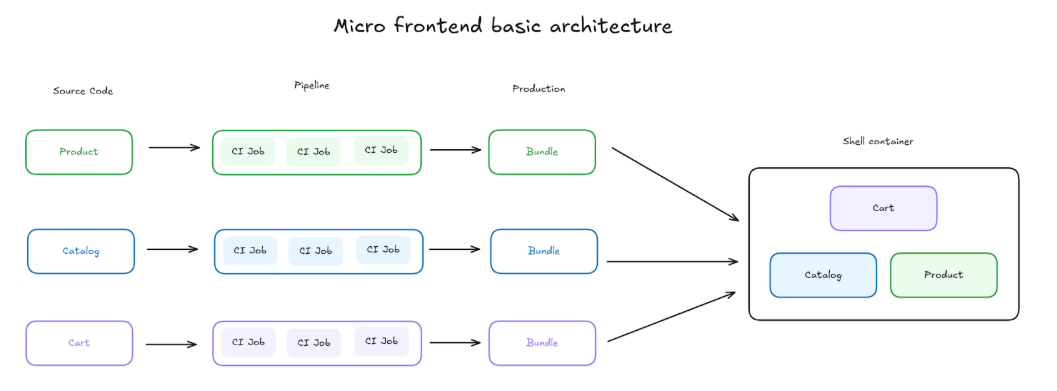
React Micro Frontend Architecture Example
Let’s explore a common micro frontend implementation that uses Webpack Module Federation with React. First, you need to configure the host ( i.e., the container) in order to use each MFE:
// webpack.config.js (host)
new ModuleFederationPlugin({
remotes: {
  products: "products@http://localhost:3001/remoteEntry.js",
  },
});
Then, you need to export the code from the remote MFE:
// webpack.config.js (remote)
new ModuleFederationPlugin({
name: "products",
filename: "remoteEntry.js",
exposes: {
  "./ProductList": "./src/ProductList",
  },
});
Finally, you have to import the MFE and use it inside the main application:
const ProductList = React.lazy(() => import("products/ProductList"));
function App() {
return (
<Suspense fallback="Loading...">
<ProductList />
</Suspense>
);
}Thanks to this pattern, you could have independent builds and deployments for each MFE while sharing runtime dependencies like React.
Frontend Architecture Patterns for Micro Frontends
Now, let’s have a look at different frontend architecture patterns that help teams avoid shared-state chaos and hidden dependencies. The first option is to apply a Vertical Slice Pattern, which implies that each micro frontend owns UI, state, API calls, and business logic for a domain. Another option is to have a lightweight shell that loads and orchestrates feature apps (this is known as the App Shell Pattern). Finally, teams could implement an Island Architecture; according to this pattern, only interactive parts are micro frontends; static content is server-rendered.
The Catch: Trade-offs and Headaches
Micro frontends are a game-changer, but let’s be real—there are some trade-offs when using them. You’re definitely adding layers of complexity, which means more tools to manage and more infrastructure to take care of. And you definitely should keep an eye on performance, because having a bunch of separate bundles flying around can, unfortunately, slow down those loading times.
Finally, one of the challenges development teams face the most is about governance. In fact, managing all the different MFEs in a way that consolidates in a single and cohesive product requires strong coordination across all of them. Also, debugging could be tough in some cases, especially when the issue affects several MFEs. This is the reason keeping each one of the MFEs as isolated as possible could improve the maintenance and monitoring of the whole application.
Honestly, micro frontends usually end up being a better fix for organizational problems than for purely technical ones.
When Micro Frontends Make Sense
When multiple teams need autonomy, release cycles must be independent, and the front end is growing faster than it can be maintained, then the use of micro frontends is recommended. Examples include:
- Big business dashboards.
- E-commerce sites are managed by multiple, independent teams.
- SaaS products with separate, modular parts.
- Businesses that are actively migrating from outdated front-end systems.
- Platforms with multiple brands that use a common core application shell
Conversely, avoid them when the team is small, the application is simple, or performance constraints are tight.
Micro Frontend Best Practices
To succeed with a micro frontend architecture, teams must commit to the following disciplines:
- Give each MFE one single responsibility (domain or business feature).
- Avoid shared state.
- Implement a unified, cross-team Design System.
- Establish a robust communication contract between the shell and micro frontends.
- Automate the build and deployment process via CI/CD pipelines.
- Implement comprehensive performance monitoring.
How Companies Successfully Implement Micro Frontends
Several teams adopt a step-by-step strategy when migrating to a micro frontend architecture. When the front-end development is at the initial stage, and the source code is small, they use a traditional modular monolith. As the project starts growing and becomes more complex, they start by isolating a single feature into a micro frontend to test the architecture. If it goes well, they move forward by creating a shared design system and implementing shared tools. Finally, they expand the adoption of the new infrastructure across all the different features gradually.
This approach aims to reduce the likelihood of problems and allows teams to build experience over time.
Wrap up
Micro frontends are more than just a trendy word. They help you when dealing with complex modern apps by splitting them into several small pieces that can work on their own. This usually results in teams working much faster and with more flexibility, ensuring the codebase remains clean and easy to manage over time.
But, as you already know, they’re not perfect. Implementing the micro frontend architecture will definitely add some layers of complexity in your infrastructure, and that’s the reason strong governance is needed in order to make the most of this pattern. Should you use good architectural know-how, you can move like lightning without everything crashing down.
Overall, MFEs are a real game-changer for big companies with long-lifecycle products. They allow development teams to escalate their development in a fast manner, while providing flexibility to accommodate the different business needs.