





Operations-First Design
Chudovo designs each WMS around the warehouse's actual operations, with the workflows, data model, and user interfaces matched to how the operations team handles receiving, picking, packing, and dispatch.
Integration-Driven Architecture
Chudovo designs the WMS architecture around the integrations the system must support, including ERP, carrier APIs, e-commerce platforms, and warehouse hardware.
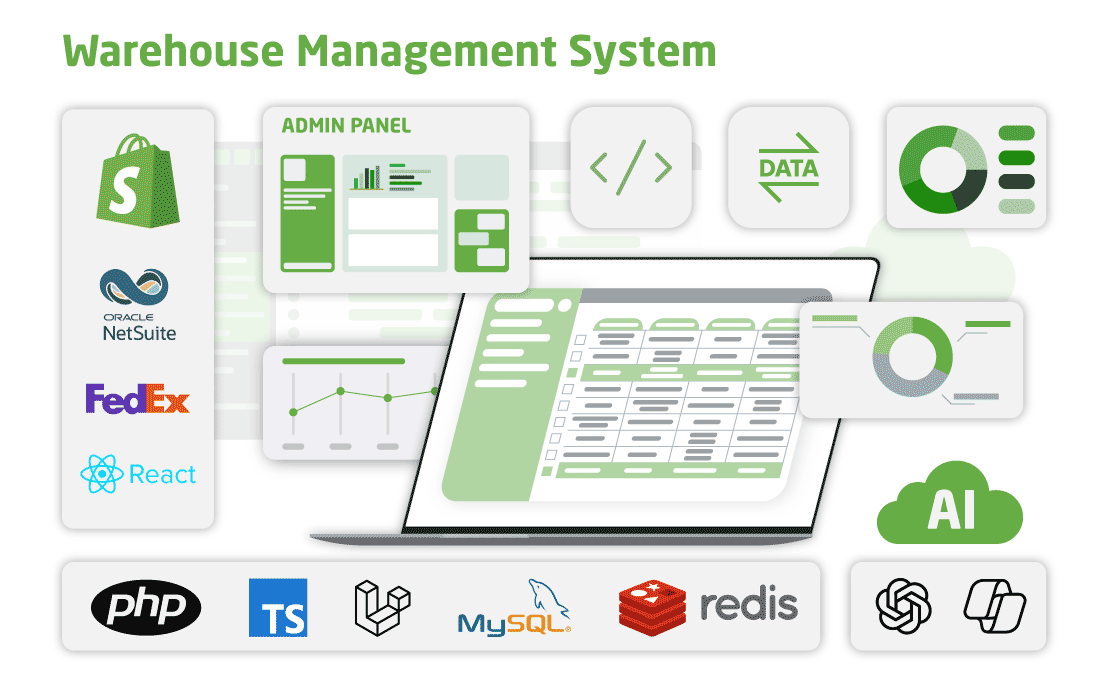
Chudovo applies an AI-assisted development approach to WMS projects, with the tools supporting work on integration code, mobile applications, and reporting layers.
WMS backends are engineered for the throughput and concurrency that high-volume operations and peak-season traffic require, with horizontal scaling and event-driven processing where the workload calls for it.

Track SKUs, lots, batches, and locations in real-time. Includes stock movement history and audit logging.

Software for the control of Automated Storage and Retrieval Systems (AS/RS), conveyor systems, sortation systems, and robotics on the warehouse floor.

Order management software that captures orders from sales channels, allocates inventory, produces picking instructions, and tracks the order through to dispatch.

Warehouse operator solutions for packing stations and system-directed picking processes (wave, batch, zone, pick-to-light, voice picking). Barcode & RFID Hardware

Scanner hardware that integrates with software to track inventory movements with hardware-level accuracy.

Reports and dashboards featuring the KPIs and visualizations that operations managers and supply chain executives require for daily decision-making and longer-term capacity planning.

Software that spans warehouse to outbound logistics; carrier APIs, transportation management systems, last-mile delivery platforms.

Manage inventory & orders across multiple warehouse locations, stock transfer logic, inventory visibility across the network, & order routing through the warehouse network.



Enterprise WMS Engineering Capability
Chudovo's engineering teams bring the back-end, integration, mobile, and hardware know-how that enterprise WMS projects require, from ERP integration through warehouse floor hardware.
Hardware and Operations Awareness
Chudovo's developers have shipped WMS solutions that work with real warehouse hardware on real warehouse floors, which matters when scanners, rugged devices, RFID readers, and automation hardware enter the project.
Integration-Heavy Project Experience
The team handles the integration scope that enterprise warehouse projects always grow into, including ERP, carriers, e-commerce, IoT devices, and BI platforms.
Long-Term Support and Evolution
WMS projects are long-term operational systems. Chudovo supports the WMS after launch, including new integrations, performance tuning, and expansion to new warehouse sites.
Real-time inventory visibility by SKU, lot, batch, and location, including movement history and audit trails.

Cycle count process, blind count, and variance reconciliation are integrated with financial reconciliation.

Mobile, portable barcode scanning for receiving, putaway, picking, packaging, and shipping

High-volume operations and high-value goods monitoring using fixed & mobile RFID scanning.

Mobile applications for portable scanners and rugged tablets in front of the operator, including support for offline mode in poor connection regions.

Live operational dashboards for warehouse supervisors & shift managers with KPI visualisation & exception warnings.

Role-based access control with unique permission sets for warehouse operators, supervisors, planners, and external users such as 3PL partners.
Custom and pre-built reports on inventory, throughput, labor productivity, and order fulfillment metrics, with the ability to export to BI systems.

Configurable processes for receiving, putaway, picking, packing, replenishment, dispatch, and returns processing.

WMS integrates with ERPs, eCommerce platforms, carriers, and other enterprise applications using REST and GraphQL APIs.